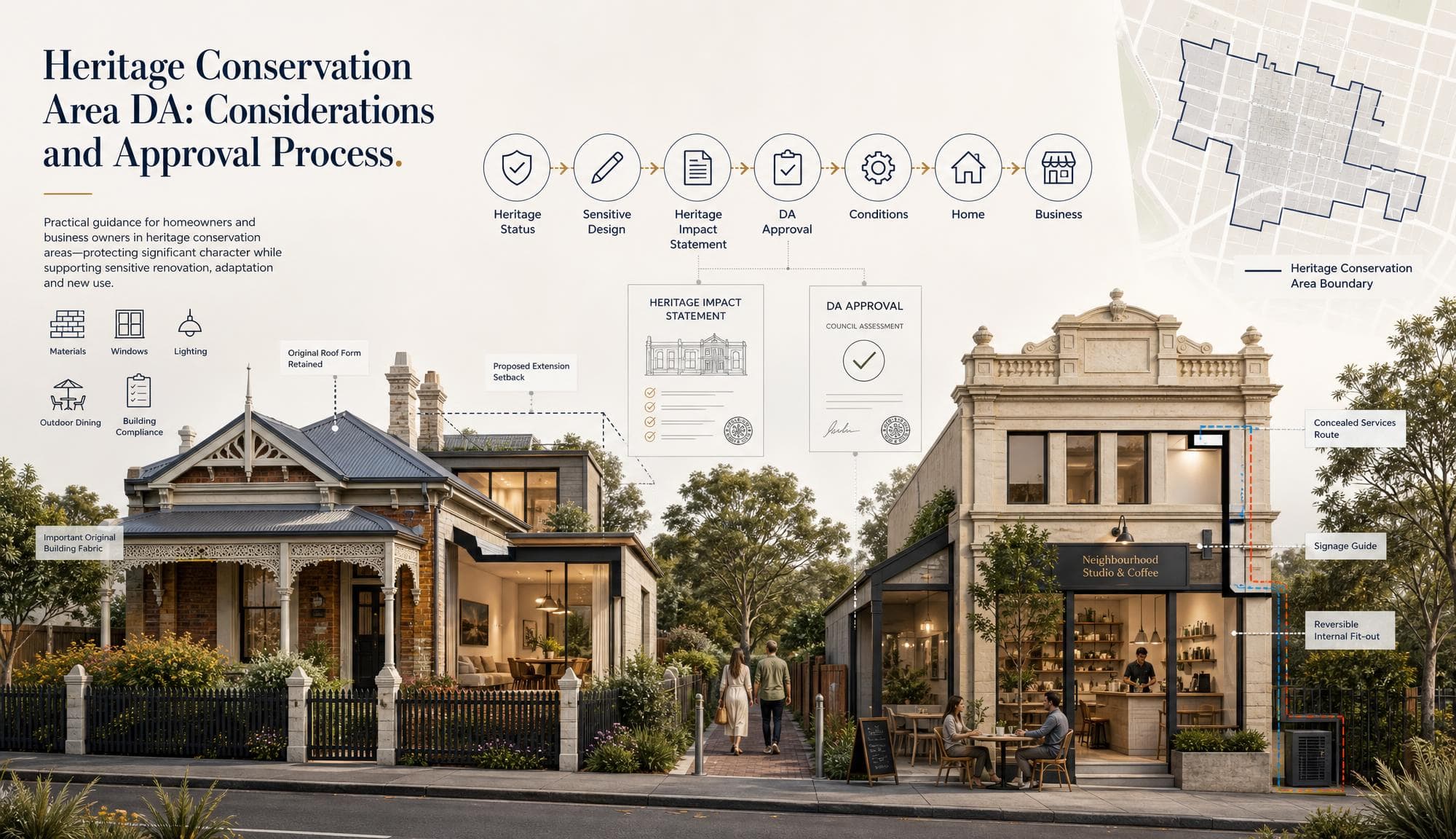
For homeowners, the focus is usually retaining character while improving a house. For business owners, the process also considers how the business will operate — signage, lighting, food service, trading hours, waste, noise and customer activity. Heritage does not stop good projects; it shapes them.
What is a heritage conservation area?
A heritage conservation area is a group of buildings, streets, landscapes or public spaces with shared historic and character value — historic town centres, Federation and Victorian residential streets, older village shopping strips, railway precincts, waterfront areas, terrace-house neighbourhoods, traditional main streets, historic commercial buildings and garden suburbs. A property does not need to be individually listed for heritage controls to apply — if it sits inside a mapped conservation area, council may assess development for its effect on the wider area.
Heritage item, conservation area and contributory building
| Term | Meaning |
|---|---|
| Heritage item | A specific building, site, structure, tree, landscape or object listed for individual significance |
| Heritage conservation area | A wider precinct valued for its combined historic character and streetscape |
| Contributory building | A building that helps create the heritage value of the conservation area |
| Non-contributory building | A newer or heavily altered building — still needs to fit the area, but with fewer constraints |
| Heritage vicinity | Land near a heritage item where development could affect its setting or views |
| State heritage item | A place listed on the NSW State Heritage Register because of its importance to the state |
Why heritage controls matter
Heritage controls do not stop appropriate development — they guide it so older places remain useful, attractive and economically active. The goal is to retain important fabric, protect streetscapes, encourage careful adaptive reuse, avoid intrusive additions and let buildings meet modern needs without losing their identity.
When is a DA required in a heritage conservation area?
A DA is commonly required where the work is not exempt development and could affect heritage significance. You may need a DA to build an extension or new structure, demolish part of a building, alter the facade or roof, replace original windows or doors, alter verandas/balconies/awnings/porches, change a shopfront, install signs, add outdoor dining, install visible services (kitchen exhausts, air-conditioning), remove original internal features, build a garage/studio/pool, alter fences or front gardens, change the use of a commercial tenancy, increase business hours or patron numbers, introduce food service or alcohol, undertake structural work, change parking or access, subdivide, or build a new dwelling or dual occupancy. In many heritage conservation areas, complying development is restricted or unavailable — proposals that might qualify for a fast-track CDC on an ordinary site often need a DA in a heritage area.
When a DA may not be required
A DA is not required for every repair, maintenance task or tenant change. Depending on the council, approval may not be needed for minor like-for-like repairs, routine maintenance, repainting in appropriate colours, small internal changes that do not affect significant fabric, a change of business tenant where the approved use does not change, minor works that qualify as exempt development, or works approved by council as minor heritage works. Rules vary — confirm before you order materials, begin demolition or sign a fit-out contract.
When is a Heritage Impact Statement needed?
A Heritage Impact Statement (HIS or SOHI) explains how a proposal affects heritage significance. It is commonly required for DAs involving heritage items, conservation areas, contributory buildings, land near heritage items, demolition, major additions, shopfront changes, signage, significant interior work, visible external services and changes of use that may affect the building or precinct.
A strong HIS usually covers the property and its heritage context; the building's contribution to the area; relevant history; important building elements and streetscape features; existing condition with photographs; a detailed description of the proposal; significance affected; the impact of the works and new use; options considered; measures that reduce heritage harm; why the preferred design is appropriate; and how new materials, signs, lighting and services will be managed.
Heritage DA vs standard DA
| Issue | Standard DA | Heritage Conservation Area DA |
|---|---|---|
| Main focus | Planning controls, design, site impacts and public interest | All standard matters plus heritage significance and area character |
| Design response | Modern planning controls | Also existing fabric, streetscape, scale, materials and historical character |
| Reports | Plans, SEE, survey, drainage and specialist reports as needed | Often includes a Heritage Impact Statement and heritage-specific drawings |
| Alterations | Modern replacements may be acceptable | Retention, repair, matching materials and reversibility are more important |
| Approval pathway | CDC may be available for eligible work | CDC availability is often more limited; a DA is more commonly needed |
| Assessment time | Depends on project complexity | Can take longer due to heritage review and design revisions |
Heritage does not mean a proposal must look old — good heritage design can be clearly contemporary. What matters is that it respects the scale, form, material quality and significant features of the place. See our Section 4.15 guide for the broader merit-assessment framework council applies alongside heritage.
Residential heritage DA considerations
For homes in heritage conservation areas, council often focuses on public-facing parts of the property and effects on the streetscape. Common residential projects include rear extensions, first-floor additions, attic conversions, new dormer windows, roof replacement, front-fence changes, new garages and carports, swimming pools, garden studios, secondary dwellings, demolition, new homes, subdivision, replacement windows and doors, veranda restoration and front-garden changes.
A strong heritage residential proposal usually retains the original front facade; places larger additions toward the rear; keeps new upper levels visually recessed; uses materials that complement the original home; retains key roof forms and chimneys; avoids oversized front garages; uses window proportions that suit the building; protects mature trees and established gardens; and makes additions clearly new but visually secondary.
Commercial and business heritage DA considerations
Commercial properties in heritage areas must respond to both building character and business operations. A DA may be required even where construction work is limited — because the use itself affects the neighbourhood through traffic, noise, waste, customer activity, deliveries, lighting or extended hours. Common proposals include shop to café/restaurant/bar, office to medical or beauty use, warehouse to gym, shopfront renewal, new signage, outdoor dining, new ventilation or kitchen exhaust, new air-conditioning plant, late-night trading, gallery or studio use and co-working spaces.
Key issues: existing shopfront condition; original windows, doors, tiles and joinery; sign location and size; awnings and verandas; window graphics and display lighting; exterior paint and finishes; mechanical exhaust routes; air-conditioning condensers; roof plant; external lighting; outdoor furniture; waste storage; delivery access; customer queues and street activation; and noise (especially at night). A café or restaurant may need to show that exhaust, grease arrestors, outdoor dining, lighting and waste storage can be accommodated without harming the building or streetscape.
Starting a business in a heritage area
Treat heritage planning as part of site selection, not a task to deal with after signing a lease. Before you commit to a shop, office, café, gym or commercial tenancy, confirm whether the property is in a heritage conservation area, is individually listed, or is a contributory building; the legally approved use; whether your proposed business is permitted in the zone; existing consent limits on hours, patrons or trading activity; whether outdoor dining is permitted; whether the building can support food preparation or mechanical ventilation; whether there is an acceptable route for exhaust ducts and air-conditioning; accessibility and fire-safety fit; and whether the business can operate within likely heritage conditions. Where possible, negotiate a lease conditional on receiving the approvals needed. For the full commercial DA lens, see our business change-of-use guide.
The heritage DA process
- Complete early due diligence. Check zoning, heritage maps and inventory records, existing consents and conditions, DCP provisions, building condition, DA/CDC/minor-works pathway and whether an HIS is needed. For complex projects a pre-lodgement meeting is often worthwhile.
- Record the existing building — facade and shopfront photos, internal heritage features, measured drawings, materials and condition survey, existing signage and services, streetscape photos, nearby heritage context and details of original windows, doors, joinery, ceilings or decorative features.
- Develop a heritage-sensitive design. Retain important original fabric, repair rather than replace, place additions behind key public views, keep new work visually secondary, use high-quality materials, keep signs proportionate, conceal services, avoid unnecessary penetrations, make fit-outs reversible, maintain shopfront proportions and use external lighting carefully.
- Prepare supporting documents — owner's consent, site survey, existing/proposed plans and elevations, sections, materials and finishes schedule, photographic survey, HIS, SEE, signage schedule, landscape plan, waste management plan, stormwater concept, BASIX certificate, EDC calculation, and any acoustic, traffic, access, fire, mechanical, Plan of Management or food-premises reports.
- Lodge the DA through the NSW Planning Portal — see our DA lodgement guide. Heritage DAs may be referred to council heritage staff, planning officers, building and fire teams, environmental health, traffic and, for State-listed sites, external heritage agencies.
- Respond to feedback. Common heritage RFIs: better photos, revised elevations, more materials detail, a clearer signage plan, service-location drawings, a stronger HIS, reduced scale, better screening of plant, changes to lighting, a revised colour palette or more information about original fabric. A constructive response is usually better than arguing.
- Receive approval and meet conditions. Heritage conditions may require retention of specific fabric, materials approval, heritage consultant inspection, photographic recording, sample panels or mock-ups, specific sign dimensions, restrictions on illumination, screening of services, approved paint colours, reversible fixing methods, construction protection measures and archaeological procedures if unexpected items are found. For businesses, conditions may also control hours, patron numbers, deliveries, waste, outdoor dining, noise, music, lighting, security and signage.
State Heritage Register sites
Some places are important at a state level and are listed on the NSW State Heritage Register. These sites can involve an additional approval pathway under the Heritage Act — the council DA may become integrated development with the heritage approval body involved in assessment. Expect a detailed HIS, a Conservation Management Plan (if required), more detailed drawings, specialist heritage advice, and additional heritage approval after DA determination. A State Heritage listing does not make adaptation impossible — but obtain specialist advice early and allow more time in your program.
What happens after DA approval?
A DA approval does not always allow you to start work or open immediately. Depending on the proposal, you may still need a Construction Certificate; appointment of a principal certifier; building inspections; fire-safety upgrades; food-business registration; liquor licence; outdoor-dining approval; separate signage approval; landowner approval; compliance with heritage conditions; and an Occupation Certificate. For a business, the OC is particularly important — it confirms that completed building work and the use of the premises are suitable for occupation under the approved documentation.
Typical timeframes
| Stage | Typical timeframe |
|---|---|
| Property checks and early advice | 1–3 weeks |
| Site record and concept design | 2–6 weeks |
| Heritage assessment and DA documentation | 3–10 weeks |
| Council assessment | Often 6–12 weeks, sometimes longer |
| Construction Certificate and detailed approvals | 2–6 weeks |
| Construction or fit-out | Varies |
| Final inspections and Occupation Certificate | Days to several weeks |
A simple residential repair or tenant change may be quicker. A major home extension, food venue, heritage shopfront, late-night business or State-listed property can take considerably longer.
Common heritage DA mistakes
- Starting work before confirming approval — replacing windows, removing walls, installing signs or fitting a kitchen exhaust without approval can trigger enforcement.
- Treating heritage as a facade-only issue — heritage may involve internal fabric, views, materials, shopfront proportions, landscaping, lighting, services and the wider streetscape.
- Using an off-the-shelf design — generic window, door, fence, signage and extension designs rarely suit a specific building or area.
- Leaving heritage advice until the end — early advice is cheaper than redesigning approved drawings or mechanical systems later.
- Assuming a CDC is available — heritage conservation areas often limit complying development. Confirm the pathway before investing in detailed design.
- Ignoring business operations — the physical design may be acceptable but operating hours, outdoor activity, noise, waste or deliveries may still need changes.
- Treating the HIS as a formality — a generic or weak HIS delays assessment. Make it specific, factual and supported by drawings and photos.
Heritage DA checklist
Before lodging, confirm you have checked heritage listing and conservation-area status; confirmed whether the property is contributory; reviewed current approvals and conditions; confirmed zoning and permissibility; chosen the right approval pathway; recorded existing fabric and conditions; prepared a heritage-sensitive design; identified heritage features to retain; planned additions, signs and services carefully; prepared a Heritage Impact Statement; prepared consistent plans, elevations and materials schedule; confirmed whether a State heritage process applies; allowed for business operations where relevant; included required specialist reports; reviewed the likely need for a Construction Certificate or OC; obtained owner, landlord or strata consent; and avoided signing an unconditional lease before understanding approval.
Frequently asked questions
Do I need a DA in a heritage conservation area?
Often, yes. A DA may be needed for external changes, additions, demolition, shopfront work, signage, business changes of use, major internal alterations and other work that could affect heritage significance. Minor like-for-like repairs or a straight tenant change may not need a DA — but confirm before you commit.
Can I renovate a house in a heritage conservation area?
Yes. Many renovations are approved. The design should retain important features, respect the streetscape and use materials and forms appropriate to the building and area. Placing additions to the rear, keeping the original roof form and matching window proportions all help.
Can I open a business in a heritage conservation area?
Yes. Heritage areas are often excellent business locations. You may need a DA if you are changing the approved use, modifying the shopfront, adding signs, installing mechanical services or altering the business operation — see our business change-of-use guide for the operational side.
Do I need a Heritage Impact Statement?
Many heritage DAs need an HIS. It explains the significance of the place, the proposed work and how heritage impacts will be avoided or reduced. For minor works the report may be brief; for a major addition, demolition or heritage item, a detailed report by a qualified heritage consultant is safer.
Can I replace original windows?
Possibly, but it depends on the building, area and proposed replacements. Council may prefer repair, matching profiles or replacement windows that preserve the original proportions and appearance.
Can I install air-conditioning or a kitchen exhaust in a heritage building?
Usually, yes — if it is carefully located and designed. Equipment should generally avoid prominent heritage facades and minimise damage to significant fabric. Concealed service routes and rear-of-building placement are the two most common wins.
Can I install a modern sign on a heritage shopfront?
Often, yes, but it may need approval. Sign size, material, colour, illumination, window coverage and position are all usually important. A restrained, well-proportioned sign is far more likely to be approved than a large illuminated box.
Does a DA approval let me open my business straight away?
Not always. You may still need construction approval, food registration, liquor approval, signage consent, inspections or an Occupation Certificate before you can trade.
Are State Heritage Register sites different?
Yes. They can involve extra assessment and a separate heritage approval process under the Heritage Act. Allow more time, and obtain specialist heritage advice early.
Check heritage requirements before you commit
Heritage constraints are easiest to manage before you finalise plans, sign a lease or start construction. Plan Advice helps NSW homeowners, architects, builders and business owners identify heritage conservation areas, understand likely DA requirements and prepare a clearer path to approval.
Important information. This guide provides general information about heritage conservation area DAs in NSW. It is not legal or planning advice. Individual councils and consent authorities apply site-specific heritage rules — always confirm current requirements with your consent authority and obtain qualified heritage advice where the outcome matters.