What is a development application?
A DA is a formal request for consent to carry out development. Your local council usually assesses a local DA, although another consent authority may be responsible for some projects.
The authority assesses your proposal against the Environmental Planning and Assessment Act 1979, relevant State Environmental Planning Policies, the local environmental plan, council development controls and the likely effects of the development. It may approve the DA, approve it with conditions or refuse it.
Not every project needs a DA. Before preparing one, check whether your work is:
- Exempt development: Minor work that can proceed without planning or building approval when every relevant standard is met.
- Complying development: A faster approval pathway for specified development that meets all required standards. Approval is given through a complying development certificate, or CDC.
- Development requiring consent: Work that requires a DA.
- Prohibited development: Development that is not permitted on the site under the applicable planning rules.
Choosing the wrong pathway wastes time and money. The NSW Government recommends checking whether development is exempt, complying or requires a DA before starting the application process (NSW Government DA guide).
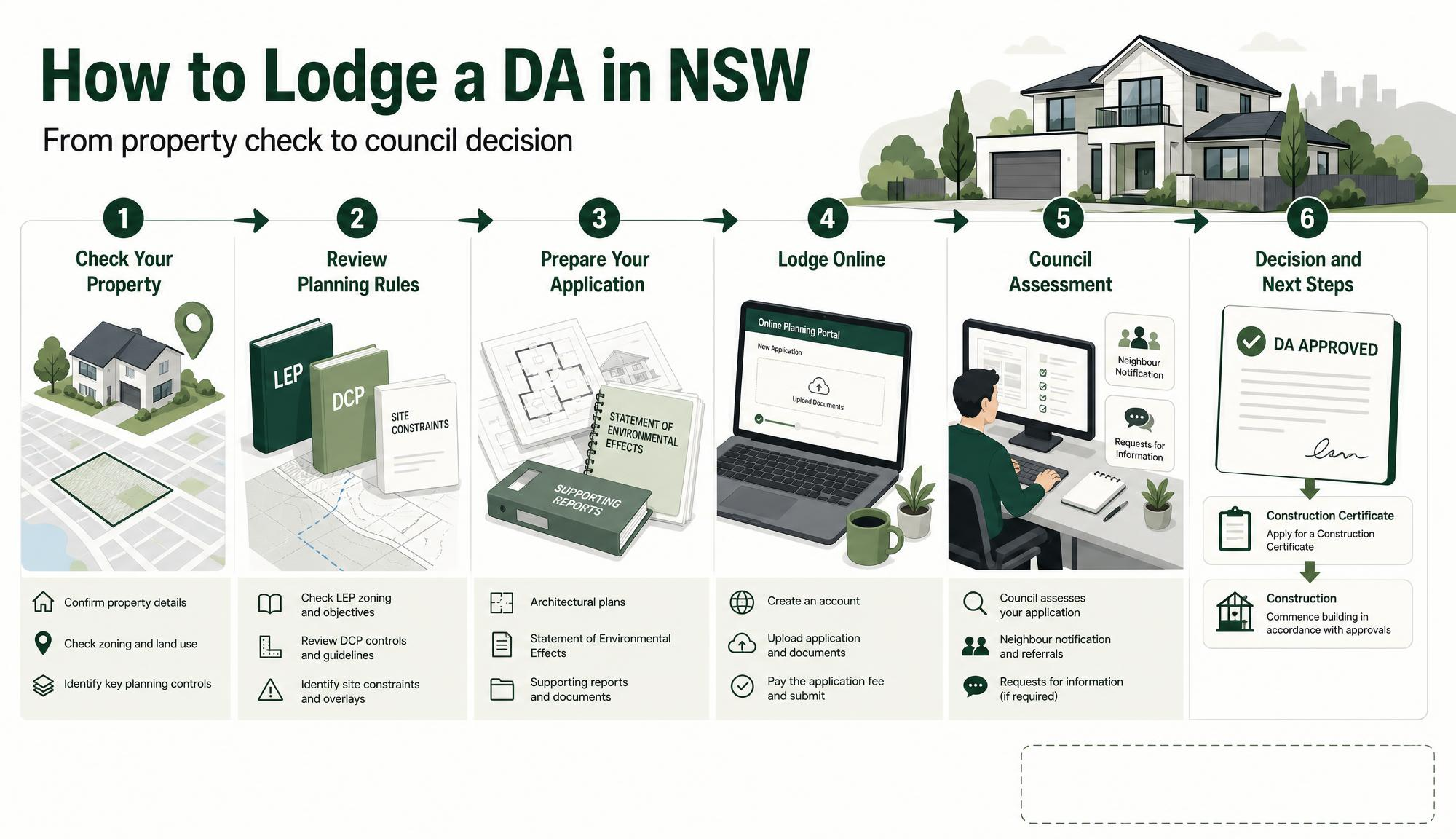
How to lodge a DA in NSW
To lodge a DA in NSW:
- Confirm that a DA is the correct approval pathway.
- Check the zoning and planning controls for the property.
- Define the proposal and prepare an initial design.
- Speak with council or obtain pre-lodgement advice if needed.
- Prepare the required plans and reports.
- Write a Statement of Environmental Effects.
- Obtain the landowner's consent.
- Create or access your NSW Planning Portal account.
- Complete the online application and upload the documents.
- Pay the required fees.
- Respond to requests during assessment.
- Review the determination and complete post-consent approvals.
Each step is explained below.
Check whether you need a DA
Your first task is to confirm the correct approval pathway. Do not assume that a small project is exempt or that a common residential project qualifies for complying development.
Eligibility may depend on:
- Land zoning
- The proposed land use
- Lot size and dimensions
- Building height and floor space
- Setbacks from boundaries
- Heritage status
- Bushfire, flooding or biodiversity constraints
- Acid sulfate soils or coastal hazards
- Whether the land is affected by an easement
- Whether every complying-development standard can be met
A single constraint can change the approval pathway. For example, a project that would normally qualify for complying development may require a DA because of the site or design.
Use the NSW Planning Portal Spatial Viewer and your council's online planning tools to investigate the property. A property report is useful, but it does not replace a full check of the relevant planning instruments.
Check the zoning and planning controls
Every NSW property is subject to planning controls. The most important documents commonly include:
- Local Environmental Plan: The LEP sets zoning, permitted uses and major development standards such as maximum building height and floor space ratio.
- Development Control Plan: The DCP contains more detailed design guidance, including setbacks, landscaping, privacy, parking and local character.
- State Environmental Planning Policies: SEPPs address matters that apply across NSW or to particular types of land and development.
- Contribution plans: These may require a payment towards local infrastructure.
- Council policies and technical guides: These can cover stormwater, waste, trees, access, heritage and engineering.
Start by answering four questions:
- Is the proposed use permitted in the zone?
- Does the proposal meet the main LEP development standards?
- Does it respond to the relevant DCP controls?
- Are there site constraints that require specialist investigation?
Do not treat a DCP variation in the same way as a breach of an LEP development standard. If a proposal seeks to vary a numerical LEP standard, such as maximum height or floor space ratio, it may require a written Clause 4.6 request. This is a detailed planning justification and should be addressed early.
Define the proposal clearly
Council cannot assess a vague idea. Before commissioning final reports, describe exactly what you intend to build or change.
Your project description should cover:
- The proposed use
- New buildings, additions or demolition
- Number of storeys
- Operating hours, staff and customer numbers for a business
- Parking, access and loading
- Tree removal and landscaping
- Earthworks and drainage
- Any subdivision
- Any variation from a planning standard or control
The written description, drawings, cost estimate and supporting reports must tell the same story. Inconsistent documents can delay the application and create uncertainty about what consent is being requested.
Consider pre-lodgement advice
Pre-lodgement advice is not required for every DA. It can be valuable when a project is complex, likely to attract objections, affected by a major constraint or seeking a significant variation.
Depending on the council and project, you may be able to:
- Speak with a duty planner
- Request written preliminary advice
- Attend a formal pre-DA meeting
- Ask council to identify likely specialist reports
- Discuss a proposed planning-control variation
Prepare for the meeting. Provide a clear proposal, concept drawings, a list of known variations and focused questions. Pre-lodgement advice is usually preliminary and does not guarantee approval.
Since 1 July 2026, the NSW Planning Portal has included a “Pre-Lodgement Advice” document type for relevant application cases, making it easier to include earlier advice with the application (NSW Planning Portal release notes).
Prepare the plans and supporting documents
The required documents depend on the proposal and council. A straightforward residential alteration needs fewer reports than a multi-unit development, subdivision or commercial change of use.
The NSW approved application requirements identify core information and documents for ordinary DAs, including applicant and property details, a description of the development, estimated cost, a Statement of Environmental Effects, a site plan and development drawings (NSW application requirements).
Common plans include:
- Site plan
- Survey plan
- Existing and proposed floor plans
- Elevations and sections
- Demolition plan
- Roof plan
- Landscape plan
- Stormwater or drainage plan
- Shadow diagrams
- Schedule of colours and materials
- Waste-management plan
- Subdivision plan, where relevant
Your plans should be drawn to scale and show dimensions, boundaries, north point, existing and proposed work, adjoining development and finished levels where relevant. Proposed parking, vehicle access, landscaping and drainage should also be shown when they form part of the development.
Additional reports may be required for:
- Heritage
- Bushfire
- Flooding
- Biodiversity
- Arboriculture
- Traffic and parking
- Acoustic impacts
- Contamination
- Geotechnical conditions
- Access and mobility
- Building Code and fire safety
- Operational management
- Social or economic impacts
Check both the statewide requirements and the relevant council DA checklist. A document can be mandatory for one project and unnecessary for another.
Prepare the Statement of Environmental Effects
Most local DAs require a Statement of Environmental Effects, commonly called an SEE. This document explains the proposal, identifies its environmental effects and shows how those effects will be avoided, reduced or managed.
At a minimum, a useful SEE should:
- Describe the site and surrounding area
- Explain the proposed development
- Identify the applicable planning controls
- Assess compliance with those controls
- Explain and justify any variations
- Consider environmental, social and amenity impacts
- Address privacy, overshadowing, noise, traffic and streetscape where relevant
- Explain measures that will reduce negative impacts
- Conclude why consent should be granted
The NSW application requirements state that an SEE must document the development's environmental impacts, explain how those impacts were identified and describe steps to protect the environment or reduce expected harm (NSW application requirements).
Avoid copying a generic template without adapting it to the property and proposal. Council assesses the actual development, so the SEE should match the drawings and directly address the controls and issues that apply.
Obtain landowner consent
If the applicant is not the owner, evidence of landowner consent may be required. This can be more complicated when:
- A property has several owners
- The owner is a company
- The property is strata-titled
- The work affects common property
- The land is owned by a public authority
- An agent is lodging for the owner
Resolve consent and authority issues before submission. The approved NSW application requirements identify evidence of owner consent as required where the applicant is not the owner and the Regulation requires that consent (NSW application requirements).
Submit through the NSW Planning Portal
Development applications in NSW are submitted online through the NSW Planning Portal. The Portal guides you through the required application information and document uploads (NSW Government DA guide).
The general process is:
- Sign in or create an account.
- Start a new development application.
- Select the relevant property.
- Enter the applicant, owner and proposal details.
- Provide the estimated development cost.
- Answer questions about the site and approval pathway.
- Identify possible external-agency referrals.
- Upload plans, the SEE and supporting documents.
- Review the application carefully.
- Make the required declarations and submit.
For applications created or submitted from 1 July 2026, applicants must answer whether the DA may need referral to an external agency or other body. The available answers are “Yes”, “No” and “Unsure”. Council may still identify a referral after submission (NSW Planning Portal release notes).
Use clear filenames such as Site Plan - Revision B - 3 August 2026.pdf. Avoid vague names such as drawing-final-new2.pdf. Check that every document is readable, correctly oriented and consistent with the latest design.
Pay the application fees
The total cost of lodging a DA may include:
- Council assessment fee
- Notification or advertising fee
- Integrated-development or referral fees
- NSW Planning Portal service fees
- Long-service levy where applicable
- Specialist review or inspection fees
- Development contributions, usually payable later if consent is granted
Fees differ by project and council. They can depend on the estimated development cost, development type and whether the proposal requires advertising, referral or specialist assessment.
NSW Planning Portal service fees are separate from fees charged by councils or private certifiers. Portal fees are paid by applicants through the Service NSW payment gateway for relevant services (NSW Planning Portal service fees).
Submission through the Portal does not always mean the application has been formally lodged for assessment. Council first reviews the material and may request missing information or payment. Check your Portal messages and email regularly.
What happens after you submit?
Council completes an initial review to decide whether the application contains enough information to proceed. It may return the application or ask for missing documents before formal lodgement.
Once lodged, the assessment may include:
- Review by a council planner
- Internal engineering, heritage, environmental or building referrals
- Referral to a NSW Government agency or other body
- Neighbour notification or public exhibition
- A site inspection
- Requests for additional information
- Design amendments
- Assessment against the matters in section 4.15 of the Environmental Planning and Assessment Act 1979
If council asks for more information, answer each point in a clear response table. Identify any revised drawings, explain what changed and make sure all affected reports are updated. Partial or inconsistent responses often lead to further delay.
From 1 July 2026, some referred applications may involve the Development Coordination Authority workflow. Applicants may receive a request to pay referral fees, and the relevant review period does not begin until those fees are paid (NSW Planning Portal release notes).
Notification and neighbour objections
Council may notify neighbours or publicly exhibit the DA under its community participation plan. Not every application is notified, and notification periods differ.
A submission does not automatically cause refusal. Council must consider the planning issues raised. Common concerns include:
- Privacy and overlooking
- Overshadowing
- Building bulk and scale
- Traffic and parking
- Noise
- Tree removal
- Drainage
- Heritage and neighbourhood character
Good plans and a clear SEE should address predictable impacts before notification. If objections are received, council may ask for a response or amended design.
The DA decision
The consent authority may:
- Approve the DA
- Approve it subject to conditions
- Refuse the DA
Read every condition carefully. Conditions may require design changes, further reports, contributions, construction controls or approvals before work starts.
If the DA is refused, or the conditions are unacceptable, review the stated reasons before deciding what to do. Depending on the circumstances and legal time limits, options may include seeking a review, modifying the design, lodging a new application or appealing to the Land and Environment Court. Obtain professional advice for a refused, contentious or high-value proposal.
What happens after DA approval?
DA consent usually does not allow you to start building immediately. Building work generally requires a Construction Certificate before it begins. You may also need to:
- Satisfy conditions that apply before a Construction Certificate
- Appoint a principal certifier
- Pay required contributions, levies or bonds
- Give notice before work starts
- Obtain separate approvals listed in the consent
- Arrange required inspections during construction
- Obtain an Occupation Certificate before occupying or using the completed work
The NSW Government's process guide treats construction and occupation certification as separate stages after DA determination (NSW Government DA guide).
Do not rely only on the approved drawings. The notice of determination and its conditions form part of the approval.
Common DA lodgement mistakes
Avoid these frequent problems:
Using the wrong approval pathway
Confirm whether the project is exempt, complying, permitted with consent or prohibited before paying for detailed documents.
Ignoring a planning-standard breach
Check building height, floor space ratio and other LEP standards early. A Clause 4.6 issue discovered late can require redesign and a new report.
Uploading incomplete or inconsistent plans
All drawings and reports should describe the same proposal, dimensions, materials and revision.
Providing a generic SEE
The SEE should address the actual site, relevant controls, environmental impacts and proposed mitigation.
Failing to check council requirements
Statewide requirements are only the starting point. Council-specific checklists and policies may add documents.
Underestimating the project cost
Use an appropriate and supportable cost estimate. Fees and other requirements may be linked to that estimate.
Treating submission as formal lodgement
Watch for council messages, invoices and requests after submitting through the Portal.
Making major changes without updating every document
When the design changes, revise the plans, SEE and specialist reports that refer to the changed element.
DA lodgement checklist
Before selecting “Submit”, confirm that:
- A DA is the correct pathway.
- The proposed use is permitted with consent.
- Zoning, LEP, DCP and relevant SEPP controls have been checked.
- Heritage, bushfire, flooding, biodiversity and other constraints have been considered.
- Any LEP development-standard breach has been identified.
- The project description is clear and consistent.
- Owner consent and applicant authority are complete.
- All plans use the latest revision.
- The SEE matches the plans.
- Required specialist reports are attached.
- The estimated development cost is supportable.
- Possible external referrals have been considered.
- Filenames are clear and documents are readable.
- Council-specific checklist items are included.
- Contact and payment details are correct.
Frequently asked questions
Do all building projects in NSW require a DA?
No. Some minor projects are exempt development, while eligible projects may use the complying-development pathway. A DA is required when the proposed development needs consent and no faster pathway applies.
Where do I lodge a DA in NSW?
Development applications are submitted online through the NSW Planning Portal. The relevant council or consent authority then reviews and assesses the application.
What documents do I need for a NSW DA?
Most local DAs need a site plan, development drawings and a Statement of Environmental Effects. Depending on the proposal and site, you may also need a survey, landscape plan, stormwater plan, BASIX certificate or specialist reports.
Do I need a Statement of Environmental Effects?
Most ordinary local DAs require an SEE. Designated development and State significant development follow different environmental-assessment requirements.
How much does it cost to lodge a DA?
The cost depends on the council, estimated development cost, proposal type and required referrals or advertising. Council assessment fees are separate from relevant NSW Planning Portal service fees.
How long does a DA take?
There is no single timeframe for every application. Timing depends on completeness, complexity, notification, referrals, council workload, requests for information and whether plans must be amended.
Can I prepare and lodge a DA myself?
Yes, an owner can often lodge an application. However, drawings and specialist reports may need to be prepared by suitably qualified people. Complex, high-risk or contentious projects may benefit from professional planning advice.
Does DA approval allow construction to start?
Usually not. Building work generally requires a Construction Certificate and satisfaction of relevant consent conditions before construction begins.
Make your DA easier to prepare
A strong DA begins before you open the NSW Planning Portal. You need to understand what is permitted, identify the issues council is likely to examine and prepare documents that answer those issues clearly.
Plan Advice helps NSW residents and businesses check zoning, test whether complying development may be available, understand likely approval issues and prepare property-specific Statements of Environmental Effects and Clause 4.6 variation reports.
Important information. This guide provides general information and does not constitute legal, planning, architectural, engineering or other professional advice. Planning requirements can change and vary between properties, councils and proposals. Confirm current requirements with the relevant consent authority and obtain professional advice where appropriate.