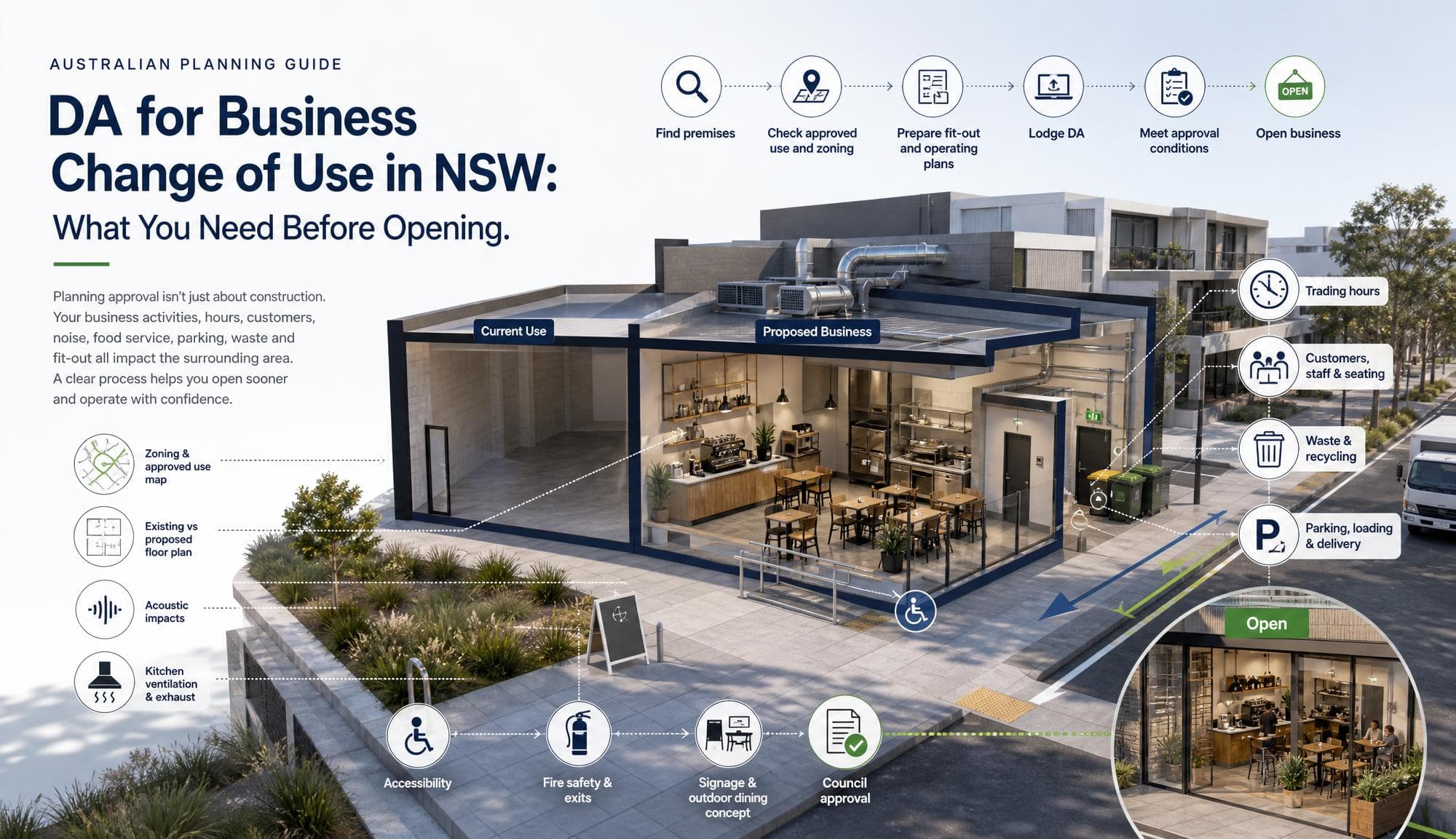
Before you spend money on renovations, furniture, equipment, signage or staff, you need to confirm whether the proposed business use is already approved for the premises. If it is not, you may need a Development Application for a change of use before you can legally open — and that includes uses that seem “obvious” for a commercial strip.
What is a change of use?
A change of use occurs when a building or premises begins operating for a different purpose than the one it was most recently approved for. The key word is approved. A tenancy may have been used as a café for years, but if the most recent lawful approval allows only a shop or office, you cannot assume a new café can operate without further approval. Confirm the approved use through the property's development history, occupation certificates, previous DAs, approved plans and conditions of consent.
Examples include a retail shop becoming an office, an office becoming a beauty salon, a shop becoming a café, a café becoming a restaurant or bar, a warehouse becoming a gym, a showroom becoming a medical centre, a retail tenancy becoming a childcare facility, an industrial building becoming a storage/distribution facility, or a vacant space becoming a studio, clinic, consulting room or event venue.
When do you need a DA for business change of use?
A DA is commonly required when you are:
- Opening a new business in a vacant premises
- Changing the approved use of an existing tenancy
- Converting a shop into a café, restaurant or bar
- Changing an office into a medical, beauty, fitness or educational use
- Changing a warehouse into a gym, recreation facility, showroom or different industrial use
- Proposing longer trading hours
- Adding outdoor dining
- Installing a commercial kitchen
- Serving alcohol
- Adding significant signage
- Undertaking structural or substantial fit-out works
- Increasing customer, staff or delivery numbers
- Changing parking, loading or waste arrangements
- Creating new noise, odour, vibration or late-night activity
- Altering a heritage building or a heritage-listed area
- Changing a use that was limited by a previous consent
You may also need a DA where the business type is permitted in the zone but the actual operation creates impacts that need council assessment. A café may be allowed in a local-centre zone, but a new café could still need a DA because of the kitchen, seating, exhaust, waste, hours, outdoor dining, signage and customer activity.
When you may not need a DA
You may not need a DA where the proposed use is already approved for the premises; you are simply changing the tenant; the new use falls within the same recognised land-use category; the change is exempt development; only minor exempt internal works are proposed; the change meets the rules for a CDC; or the existing consent expressly allows the proposed use, hours and operational scale. A clothing shop changing ownership or brand name is normally a tenancy change, not a planning change of use. Do not rely on assumptions or verbal comments from an agent or landlord — check the most recent consent, any conditions attached to it and the approved plans.
The three approval pathways
| Pathway | When it may apply | Typical example |
|---|---|---|
| Exempt development | Minor change within an approved business category, with only low-impact work | Shop changes tenant and receives new internal shelves and repainting |
| CDC | Eligible business or industrial change of use that meets fixed standards | Compliant office, shop or warehouse change of use with no major site constraints |
| DA | Change requires planning judgement, building work, new impacts or a non-standard use | Shop converted into a café with kitchen, outdoor seating and later hours |
A CDC can be useful for eligible commercial and industrial changes of use — but only if the proposal meets every applicable standard. If the proposal needs flexibility, creates material impacts or requires council discretion, a DA is usually the correct path.
Start with the approved use, not the new idea
Many new business owners start by asking, “Is my business allowed in this zone?” That is important, but only the first question. You also need to ask what the premises is currently approved for; what your proposed business counts as under planning definitions; whether that use is permitted in the zone; whether the existing consent limits hours, patron numbers, parking, noise, waste or deliveries; whether the fit-out will change the building classification or fire-safety requirements; and whether the new operation creates new impacts that need approval. A business may be permitted in the zone but still need a DA because the tenancy does not have approval for that particular use or operating model.
Check the planning definition of your business
Planning rules use defined land-use terms — your business name does not determine the planning category. For example:
- A “wellness studio” could be a gym, recreation facility, health consulting room or education facility.
- A “creative hub” could be office premises, community facility, entertainment facility or function centre.
- A “coffee bar” could be a café, restaurant, food and drink premises or small bar.
- A “beauty clinic” could be a business premises, health consulting room or medical centre.
- A “showroom” may be retail premises, industrial retail outlet, warehouse or business premises.
The correct definition affects whether the use is permitted, whether it needs consent and which controls apply. Before signing a lease, obtain clear advice on the planning definition that best matches your actual operation — not just the marketing description.
How a business DA differs from a residential DA
| Topic | Residential DA | Business Change-of-Use DA |
|---|---|---|
| Main question | Is the building design appropriate for the site? | Is the business use and operation appropriate for the premises and area? |
| Common documents | Architectural plans, site survey, shadow diagrams, drainage plans | Existing and proposed plans, operational details, Plan of Management, waste, parking, acoustic and fire-safety information |
| Key impacts | Height, setbacks, solar access, privacy, visual bulk | Noise, trading hours, customer numbers, parking, deliveries, waste, odour, safety and amenity |
| Neighbour impacts | Overlooking, shadows, scale | Noise, late-night activity, traffic, queues, deliveries, cooking smells and outdoor activity |
| Building works | Usually central to the application | May be minor, but a DA may still be needed because the use changes |
| Ongoing controls | Often focuses on construction and landscape conditions | May include operational conditions after opening |
A commercial DA may involve very little construction work. You can need a DA simply because the way the premises will operate is changing — that is why a business DA feels different from the merit-assessment lens described in our Section 4.15 guide.
Common business types that need careful checks
Cafés, restaurants and food businesses
Food businesses are among the most common change-of-use applications. A café, takeaway, restaurant, bakery, bar or food hall may need approval because it involves commercial kitchen equipment, cooking odours, exhaust systems, grease arrestors, plumbing changes, food storage, waste and recycling, outdoor dining, deliveries, seating, late trading, alcohol service, noise from patrons and music, and signage. A premises previously used as a retail shop may not automatically be approved for food and drink use.
Medical, health and beauty uses
Medical centres, dental surgeries, allied-health practices, cosmetic clinics, massage premises, beauty salons and similar uses may need approval because of patient visits, parking demand, accessible access, medical waste, treatment rooms, extended operating hours, noise or privacy impacts, change in building classification and health-service requirements.
Gyms, studios and recreation uses
Gyms, Pilates studios, dance studios, martial-arts schools and indoor recreation can create concerns about noise and vibration, amplified music, customer arrivals and departures, early-morning or late-night hours, parking, building acoustics, floor loading, emergency access and change-of-use classification. A gym in an upper-floor tenancy may need detailed acoustic evidence.
Childcare and education uses
Childcare centres, tutoring centres, training facilities and educational establishments often need detailed assessment because of drop-off and pick-up traffic, noise, outdoor play, parking, staffing, access and safety, hours of operation and building-code compliance.
Warehouses, industrial and storage uses
Industrial changes of use can involve vehicle movements, loading and unloading, heavy vehicles, noise, storage of goods, dangerous goods, waste, fire safety, mechanical plant, operating hours and site contamination. A warehouse may be suitable for one industrial use but not another — storage facility, distribution hub, panel-beating and light manufacturing can have very different planning impacts.
The business DA process: lease to opening day
Stage 1 — Check the site before signing a lease
The best time to investigate planning approval is before you sign an unconditional lease. Ask the landlord or agent for the latest development consent, approved plans, conditions of consent, Occupation Certificate, building classification details, fire-safety documentation, previous use details, any existing Plan of Management, and information about heritage, flooding or other constraints. Also check zoning and permissible uses, LEP and DCP controls, existing approvals and restrictions, parking and loading arrangements, waste storage, access requirements, signage rules, outdoor-dining approvals and any existing liquor licences.
Where possible, negotiate a lease clause that makes the lease conditional on receiving the approvals needed for your intended business — often called a due diligence clause, planning approval clause or DA condition precedent.
Stage 2 — Confirm the planning pathway
Determine whether the project is a tenant change only, exempt development, eligible for a CDC, a DA change of use, a DA plus Construction Certificate, or a DA plus other separate approvals. For uncertain, complex or high-value projects, a pre-lodgement meeting with council can help identify required reports, likely concerns and the right strategy before you spend heavily on fit-out plans.
Stage 3 — Prepare the operational brief
A business DA needs a clear description of what the business will actually do. Prepare a short operational brief covering business type, proposed planning use, staff numbers, maximum customers/patrons/students, seating numbers, trading hours, delivery times, waste-collection arrangements, parking and access, outdoor areas, music/noise/amplified sound, cooking/ventilation/odour sources, alcohol service, security arrangements, cleaning and management procedures, proposed signage and fit-out works. Do not understate the operation — council will assess the real business model, not a vague description.
Stage 4 — Prepare plans and technical documents
A typical change-of-use DA may include:
- Owner's consent
- Site plan
- Existing and proposed floor plans
- Elevations, where external changes are proposed
- Signage plan
- Survey plan, where relevant
- Existing and proposed use details
- Estimated Development Cost calculation
- Statement of Environmental Effects
- Plan of Management
- Waste Management Plan
- Traffic and parking assessment
- Acoustic report
- Mechanical ventilation details
- Food-premises plans
- Accessibility report
- Fire-safety upgrade assessment
- Heritage Impact Statement
- Flood, bushfire, contamination or geotechnical reports
- Outdoor-dining plan and landscape plan, where relevant
Stage 5 — Lodge the DA
Most NSW DAs are lodged online through the NSW Planning Portal. The application typically includes a detailed description of development, owner's consent, plans, environmental assessment documentation, EDC, supporting reports and relevant fees. See our DA lodgement guide for the step-by-step Portal walkthrough. Council will review the application for completeness — missing documents typically trigger a request for more information before formal assessment begins.
Stage 6 — Council assessment and notification
Council assesses the DA against planning controls and likely impacts, and may refer the application internally to teams dealing with planning, building compliance, environmental health, traffic and transport, waste, heritage, trees and landscaping, drainage, fire safety, noise and food regulation. The DA may also be notified to nearby owners or publicly exhibited. Common RFIs for business DAs relate to operating hours, patron numbers, parking, noise, waste, outdoor seating, mechanical ventilation, fire safety, signage, accessibility, food-business design, deliveries and plan inconsistencies.
Stage 7 — Receive development consent
If approved, council issues a development consent with conditions. Read every condition carefully. Business owners often focus on the approval headline and miss operating restrictions that affect the business model. Conditions may control approved use, maximum patron or staff numbers, trading hours, outdoor dining, alcohol service, noise limits, music, waste storage and collection times, delivery times, signage, parking, security, lighting, exhaust systems, fire-safety work, building upgrades and Plan of Management requirements. A DA approval does not always let you open immediately.
What happens after DA approval?
Construction Certificate or CDC for building work
If the DA includes building work, you will commonly need a Construction Certificate before starting that work. The CC confirms detailed plans comply with the Building Code of Australia, approved DA plans and relevant conditions — covering structural work, fire safety, accessibility, sanitary facilities, ventilation, energy efficiency, building services, waterproofing and mechanical systems.
Fire safety upgrades
A change of use can trigger new fire-safety requirements because the building classification or risk profile may change — upgrades may be needed to fire exits, emergency lighting, smoke detection, fire doors, hydrants, hose reels, sprinklers, exit signage and fire safety schedules. Do not assume an existing building is automatically compliant for your new use.
Food business registration and inspections
If you are opening a food business, you may need to register with the relevant council or food authority before trading — food-compliant finishes and fixtures, handwashing facilities, food-preparation areas, waste storage, grease arrestors, mechanical exhaust, pest-control arrangements, food safety supervision and inspection before opening.
Liquor licence
If your business will serve alcohol, you may need a separate liquor licence or licence variation. Planning approval and liquor licensing are different processes — align hours, patron numbers, operational model and entertainment plans across both.
Outdoor dining and use of public land
Outdoor dining may need separate approval where tables and chairs are proposed on a footpath, public plaza or road reserve — often a council footpath licence, public-liability insurance, furniture layout, accessibility clearances, waste controls and outdoor-dining conditions.
Signage approval
Signage is often treated separately from the main business use. A new awning sign, illuminated sign, window display, projecting sign, fascia sign or digital sign may require its own approval — check early rather than assuming your shopfront sign is automatically permitted.
Occupation Certificate
Where building work or a change in building use requires it, you may need an Occupation Certificate before occupying the premises or opening to customers. The OC confirms that relevant works are complete and the building is suitable for occupation in line with the approved use.
Typical timeframes
| Stage | Typical timing |
|---|---|
| Early planning and property checks | 1–3 weeks |
| Design and supporting reports | 2–8 weeks |
| DA assessment | Often 6–12 weeks, sometimes longer |
| Construction Certificate and final documentation | 2–6 weeks |
| Fit-out construction | Varies widely |
| Final inspections and Occupation Certificate | Days to several weeks |
A straightforward business change with minimal works may move faster. A food venue, gym, medical use, licensed venue, childcare centre or heritage site can take substantially longer. Do not announce an opening date, hire a full team or order expensive equipment until you understand the approval pathway and likely timing.
Common mistakes new business owners make
Signing a lease before checking approvals
A beautiful shopfront does not guarantee your business can legally operate there. Check the approved use, zoning, consent conditions, building classification and operating restrictions before committing.
Assuming the previous tenant had the same use
A previous business may have had a different approval, different hours, different patron numbers or a temporary arrangement. Confirm the records.
Describing the business too broadly
A vague description creates confusion. Clearly explain the real use, hours, customers, equipment, noise and waste.
Forgetting that fit-out work may need approval
Internal changes can trigger building, fire, accessibility, plumbing or ventilation requirements even when they look minor.
Treating a DA as the final step
You may still need a Construction Certificate, food registration, liquor licence, outdoor-dining approval, signage approval, fire-safety upgrades and an Occupation Certificate.
Ignoring operating conditions
Your consent may limit hours, deliveries, music, outdoor seating or customer capacity. Make sure the approved operation still supports your business plan.
Leaving specialist reports too late
Acoustic, waste, traffic, access and mechanical-ventilation issues are easier to solve before the layout and lease terms are locked in.
Business change-of-use checklist
Before you commit to a premises, confirm:
- The existing approved use
- The proposed planning definition of your business
- Whether the use is permitted in the zone
- Whether a DA, CDC or no approval is required
- Existing consent conditions and approved hours
- Customer and staff limits
- Parking and loading arrangements
- Waste storage and collection
- Noise and vibration risks
- Food, liquor or outdoor-dining requirements
- Fire safety and building classification
- Accessibility requirements
- Heritage, flood, bushfire or contamination constraints
- Signage restrictions
- Whether fit-out works need a Construction Certificate
- Whether an Occupation Certificate is required before opening
- Whether your lease is conditional on approval
Frequently asked questions
Do I need a DA to open a business in an existing shop?
Not always. If the premises already has approval for the same business use and you are only changing tenants, a DA may not be needed. If the new use differs from the approved use or creates new impacts — hours, patron numbers, cooking, alcohol, noise, deliveries — you may need a DA.
Do I need a DA to change a shop into a café?
Often, yes. A café can involve food preparation, exhaust systems, customer seating, waste, noise, deliveries, trading hours and outdoor dining. These factors commonly require planning assessment even if the tenancy shell stays the same.
Can I open my business while the DA is being assessed?
Usually no. You should not begin operating a new use until you have the required planning approval and any other approvals needed for occupation and operation.
What is the difference between a business DA and a residential DA?
A residential DA mainly assesses building design and impacts such as height, setbacks, privacy and shadow. A business DA focuses strongly on how the premises will operate — hours, customers, parking, noise, waste, deliveries, safety and amenity.
Can I use a CDC for a business change of use?
Possibly. Some business and industrial changes of use can use a CDC if they meet all eligibility requirements and fixed standards. If the site is constrained or the operation needs planning discretion, a DA is more likely.
Does a business DA cover signage?
Sometimes, but not always. Check whether signage is included in the DA description and plans. Separate signage approval may still be needed for awning signs, illuminated signs, projecting signs or digital displays.
Do I need a liquor licence after DA approval?
If you plan to sell or supply alcohol, you may need a separate liquor licence or licence variation. DA approval and liquor licensing are separate requirements — align hours, patron numbers and management plans across both processes.
What happens if I open without approval?
Operating without the required approval can expose you to enforcement action, penalties, orders to stop operating and difficulty obtaining later approvals. It can also affect your lease and insurance.
Check your business premises before you commit
The best time to investigate a business change of use is before signing an unconditional lease or spending money on fit-out. Plan Advice helps NSW business owners assess a proposed premises before they commit — enter the address and describe your business to identify likely zoning controls, change-of-use issues, approval pathways, specialist reports and key questions to resolve before opening.
Important information. This guide provides general information about business change-of-use Development Applications in NSW. It is not legal, planning, licensing or building-code advice. Individual councils and consent authorities apply site-specific rules — always confirm current requirements with your consent authority and obtain professional advice for material decisions.