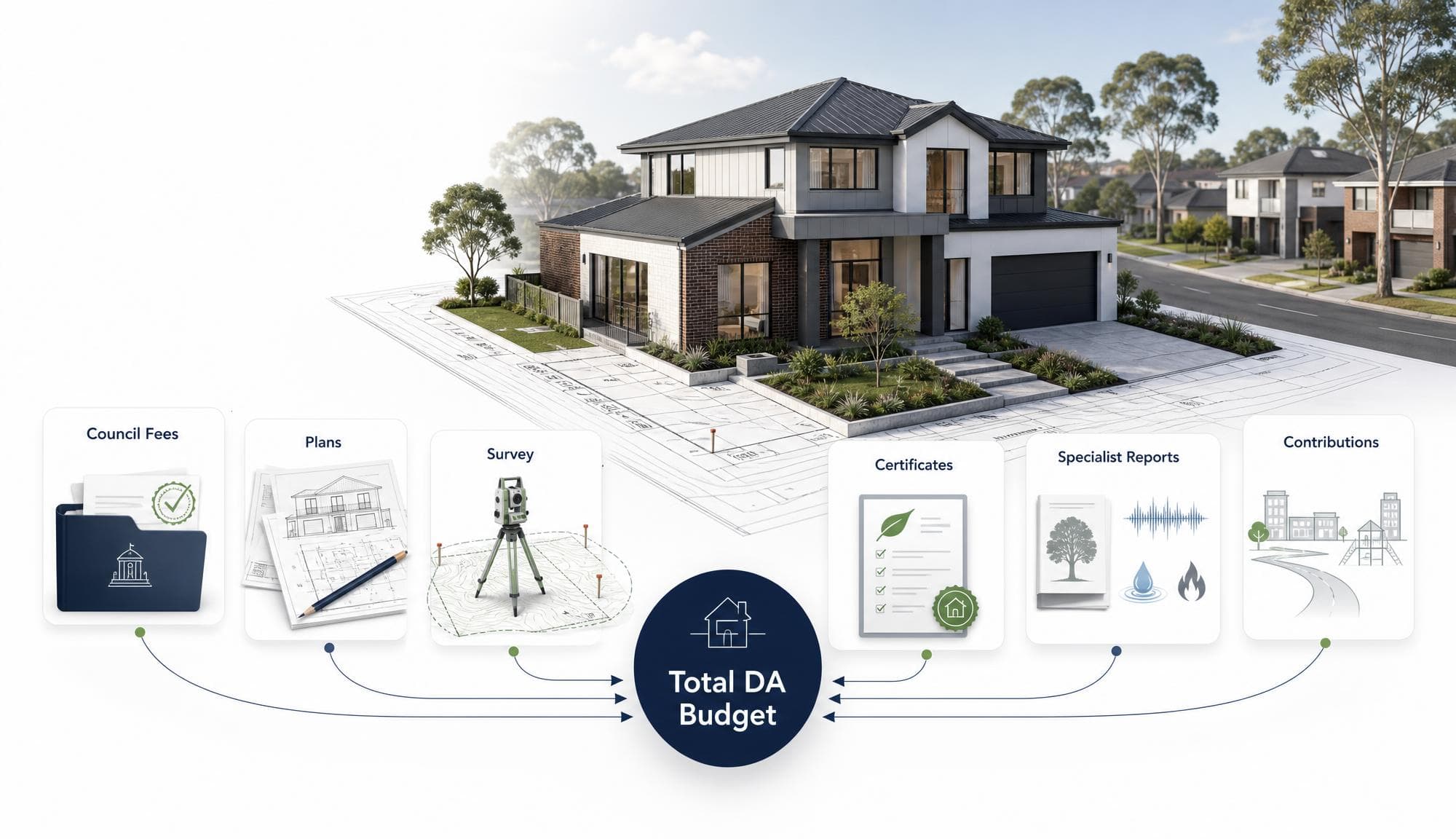
If you're planning to build, extend, or renovate in New South Wales, one of the first questions you'll ask is: how much does a DA cost? The short answer is that a Development Application in NSW costs anywhere from $144 in council fees for minor works to $8,000–$30,000 or more all-in for a new dwelling, once you factor in plans, surveys, certificates, and specialist reports.
The longer answer — and the one that will actually help you budget — is that the council lodgement fee is often the smallest part of what a DA really costs. This guide breaks down every fee you'll encounter, from the official council fee scale through to consultants, contributions, and the costs most people forget about until the invoice arrives.
What is a Development Application?
A Development Application is a formal request submitted to your local council seeking permission to carry out development — everything from building a new home or granny flat to subdividing land, adding a second storey, or changing the use of a commercial premises. The DA is assessed against your council's Local Environmental Plan (LEP), Development Control Plan (DCP), and state planning policies.
Not every project needs a DA. Many straightforward residential projects can be approved as a Complying Development Certificate (CDC) instead, which is faster and generally cheaper. We'll cover that distinction later, because choosing the wrong approval pathway is one of the most expensive mistakes homeowners make (see our CDC vs DA comparison guide).
Council DA fees: the official NSW fee scale
Council DA fees in NSW are regulated under the Environmental Planning and Assessment Regulation 2021. Every council uses the same statutory fee scale, calculated on a sliding scale based on your project's Estimated Development Cost (EDC) — the genuine cost of completing the works.
| Estimated Development Cost | Council DA fee (2024/25 rates) |
|---|---|
| Less than $5,000 | $144 |
| $5,001 – $50,000 | $220 + $3 per $1,000 over $5,000 |
| $50,001 – $250,000 | $459 + $3.64 per $1,000 over $50,000 |
| $250,001 – $500,000 | $1,509 + $2.34 per $1,000 over $250,000 |
| $500,001 – $1,000,000 | $2,272 + $1.64 per $1,000 over $500,000 |
| $1,000,001 – $10,000,000 | $3,404 + $1.44 per $1,000 over $1M |
A worked example
Say you're building a $750,000 new home. Your council fee would be:
- Base fee (for the $500,001–$1,000,000 bracket): $2,272
- Plus $1.64 per $1,000 over $500,000 (that's $250,000 × $1.64/$1,000): $410
Total council DA fee: $2,682
Fees increase every year
The NSW fee unit is indexed annually. It rose from $111.32 to $113.90 for the 2025/26 financial year starting 1 July 2025, and you can expect a further adjustment for 2026/27. Always confirm current rates with your council before lodging — and check whether your council offers an online DA fee calculator, as Newcastle City Council and Tweed Shire Council both do.
The hidden costs: what a DA really costs
Here's the truth that catches most first-timers off guard: the council fee is often just 10–20% of your total DA spend. A typical residential DA requires a stack of supporting documents and professional services.
Design and architectural plans
Council won't accept a sketch on the back of an envelope. You'll need a full set of architectural plans — floor plans, elevations, sections, shadow diagrams, and a site plan — prepared by an architect, building designer, or draftsperson.
- Typical cost: $3,000–$15,000 depending on project complexity
- For a standard single dwelling, expect architect fees of $3,000–$8,000 specifically for DA documentation
Land survey
Almost every DA requires a current survey of your lot showing boundaries, contours, existing structures, and easements.
- Typical cost: $1,500–$3,500, with $1,000–$2,000 being common for straightforward residential lots
Statement of Environmental Effects (SEE)
The SEE is the narrative document that explains your proposal and demonstrates compliance with planning controls. Councils require one with virtually every DA.
- If you engage a town planner to prepare it, expect to pay $800–$2,500, with basic reports running $500–$1,800 plus GST depending on complexity.
BASIX certificate
For any residential development in NSW, a BASIX (Building Sustainability Index) certificate is mandatory.
- Typical cost: $300–$800
Specialist reports
Depending on your site and project, council may require additional expert reports:
- Bushfire assessment (BAL rating)
- Stormwater management plan
- Heritage Impact Statement
- Acoustic report
- Arborist report / tree assessment
- Flood study or geotechnical report
Each typically costs $500–$3,000, and it's not unusual for a constrained site to need three or four of them.
Notification and advertising fees
Most DAs must be notified to adjoining neighbours, and some must be publicly advertised.
- Neighbour notification: $294–$541 depending on the value of works
Total DA costs by project type
Putting it all together, here's what you should realistically budget.
| Project type | Estimated total DA cost |
|---|---|
| Small extension on a simple block | $4,000 – $12,000 |
| New single dwelling | $8,000 – $30,000+ |
| New dwelling (typical breakdown) | Council fees $500–$2,000 · town planner $2,000–$4,000 · architect $3,000–$8,000 · surveyor $1,000–$2,000 |
| Medium-scale development (duplex, small townhouse) | $15,000 – $50,000 |
| Complex commercial or multi-unit development | $100,000+ |
These figures cover getting the DA lodged and assessed — not construction costs, and not post-approval costs like the Construction Certificate.
Don't forget Section 7.12 contributions
This is the big one people miss. On top of application fees, most NSW councils levy development contributions under Section 7.12 of the Environmental Planning and Assessment Act. For residential projects, this is typically 1% of the development cost — meaning a $750,000 build could attract roughly $7,500 in contributions. Some councils use Section 7.11 contribution plans instead, with fixed charges per dwelling or per lot, and these can be significantly higher in growth areas.
Contributions are usually payable before the Construction Certificate is issued, so they hit your budget after DA approval but before you can start building.
DA vs CDC: choosing the right pathway
Before lodging a DA, check whether your project qualifies as Complying Development under the NSW Housing Code or the relevant State Environmental Planning Policy. A CDC:
- Is assessed by a council or private certifier against fixed standards
- Doesn't require a DA, SEE, or neighbour notification
- Is typically faster (often days rather than months)
If your design is compliant and your site is unconstrained, a CDC can save you thousands in consultant fees and months of assessment time. However, if you want flexibility — a design that doesn't neatly fit the complying development standards — the DA pathway gives council room to exercise discretion. Read the full breakdown in our CDC vs DA guide.
How to reduce your DA costs
1. Get a preliminary planning report first
Before spending $10,000+ on full documentation, a preliminary planning report (typically $690–$1,500 depending on scope) will identify your site's constraints, the applicable planning controls, and whether your proposal is likely to be supported. Discovering a heritage overlay, flood constraint, or bushfire issue before you've paid for full plans can save you from redesigning everything.
2. Use your council's free DA fee calculator
Many councils publish online fee calculators — Newcastle City Council and Tweed Shire Council both offer tools that estimate your DA fees based on project details. Five minutes with a calculator beats a nasty surprise at lodgement.
3. Talk to council before you lodge
Most councils offer pre-DA meetings (some free, some for a modest fee). A pre-lodgement conversation can confirm exactly which reports council will require — so you don't pay for an acoustic report nobody asked for, or worse, get a Request for Information demanding one you didn't budget for.
4. Accurately estimate your development cost
Your EDC directly determines your council fee and contributions. Underestimating it is risky — councils can (and do) require independent cost verification — but a realistic, well-documented estimate from a quantity surveyor or qualified estimator ensures you're not paying more than necessary.
5. Engage the right professionals for the job
You don't need an architect for a carport. Match the professional to the project: a draftsperson or building designer for simple works, an architect for complex or design-sensitive projects, and a town planner whenever the planning pathway is uncertain. Town planners typically charge $150–$300 per hour, or $2,000–$5,000 for full DA preparation.
Do DA costs vary between councils?
Yes — while the statutory DA fee scale is the same statewide, actual total costs vary slightly by council and are updated annually. Differences arise from:
- Council-specific fees for notification, advertising, and integrated development
- Varying Section 7.11/7.12 contribution rates
- Different documentation requirements (heritage-heavy inner-city councils often demand more reports than regional councils)
- Some councils charging for pre-DA meetings and planning certificates
Sydney's inner-city and metropolitan councils generally sit at the more expensive end, while regional and rural councils tend to have lower total costs — though bushfire and flood-prone regional sites can rack up specialist report costs that erase the difference.
Frequently asked questions
How much is the council fee for a DA in NSW?
Usually a few hundred to a few thousand dollars for residential projects, calculated on a sliding scale based on your cost of works.
How much does a town planner charge in NSW?
Typically $150–$300 per hour, or $2,000–$5,000 for end-to-end DA preparation.
What's the difference between a DA fee and the total DA cost?
The DA fee is what council charges to assess your application. The total DA cost includes plans, surveys, certificates, consultant reports, and contributions — often 5–10 times the council fee.
Do I have to pay development contributions on top of DA fees?
Usually yes. Section 7.12 contributions are commonly 1% of the development cost for residential projects.
Are DA fees refundable if my application is refused?
Generally no — council fees cover the cost of assessment, which happens regardless of the outcome.
The bottom line
Budget $4,000–$12,000 for a simple extension, $8,000–$30,000 for a new dwelling, and $15,000–$50,000 for a medium-scale development — plus contributions. The projects that blow out are almost always the ones where the owner skipped the early planning work: a preliminary report, a check against the CDC pathway, and a realistic scope of required reports. Spend a few hundred dollars understanding your site first, and you'll save thousands on the DA itself.
Skip the guesswork — start with your property
Plan Advice runs a free property analysis in about 90 seconds — confirming zoning, pathway options, likely constraints and the reports council will look for. Do this before you commission plans, not after.
Important information. Fee figures cited here are based on the Environmental Planning and Assessment Regulation 2021 and publicly available council schedules current at the time of writing. Rates change annually and council-specific charges vary. Always confirm current fees directly with the consent authority before lodging. This guide is general information only and does not constitute legal, planning or professional advice.